English
  Japanese
  Chinese (China)
  Chinese (Taiwan)
  Korean
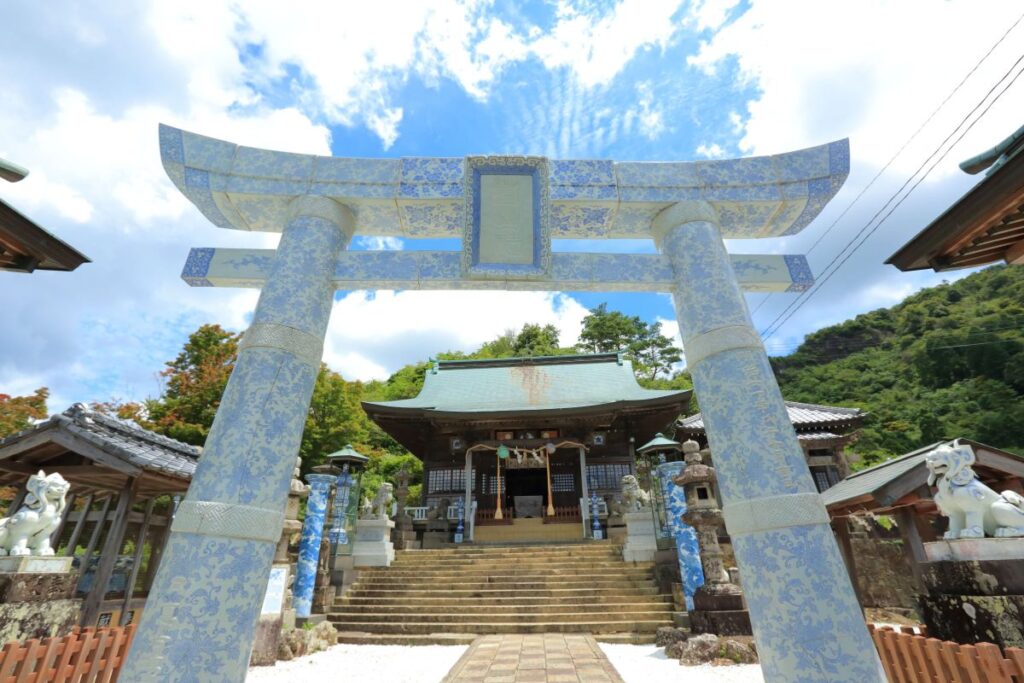
Arita-cho, which is famous as the birthplace of Aritayaki. Appropriate to the town of pottery, there is a rare shurine "Sueyama Jinja" in Japan, where torii, komainu and lanterns are made of pottery. In addition, Aritayaki's amulets and red seal books are also available at this shrine. The surprise sight of a train running through the precinct is also hard to miss.
A shrinen like open-air museum in a town of pottery
Located in on the prefectural border of the northern part of Saga and Nagasaki, Arita-cho is Japan's first porcelain production site. Aritayaki boasts about 400 years of history, has been exported abroad since the Edo period, and porcelain with beautiful painting on its crystal-clear white porcelain skin is also loved in Europe.
Located on a high ground overlooking the town, "Sueyama Jinja" was founded in the first year of Manji (1658) as "Arita Sarayama Sōbyō Hachimangu" . It was later renamed after the general name of this district in 1871. The founder of Aritayaki, Li Sanpei, who discovered good quality pottery stone in the Aritacho Izumiyama, is also enshrined.
The official reading is "Sueyama", but locally it is known as "Touzan", and it is the very god of ceramics. You can see the pottery torii and the komainu, which are rare in the whole Japan, and the landscape is so called "Aritayaki's Open Air Art Museum".
Aritayaki items such as Torii, Komainu and Toro are scattered in the precincts
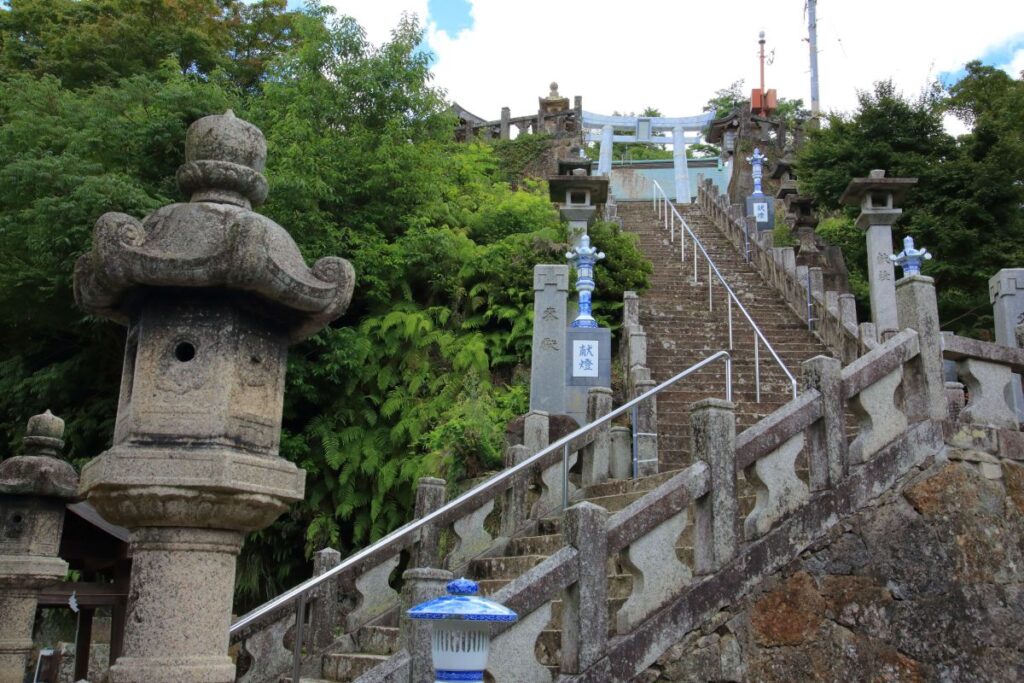
First, I discovered Aritayaki lanterns on the side of the steep stairs leading to the shrine. It is said that it was dedicated so that the pottery could be seen from below, because "it would be difficult for the old worshipers to climb this staircase." It's heartwarming episode.
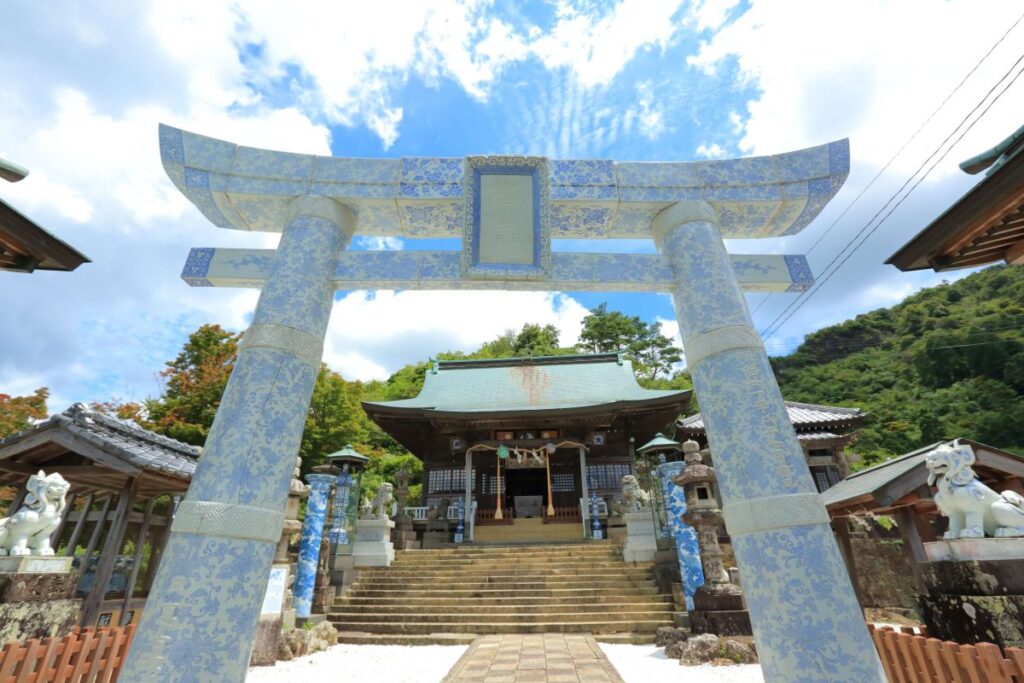
When you finish up the 72 steps, you will be greeted by Aritayaki Otorii, a symbol of the shrine. The Oorii, which contains white porcelain with a pale blue arabesque pattern of natural Gosu, is 3.7m high and 3.9m wide. It was donated by Aritayaki potters in 1888 and has been designated as a National Registered Tangible Cultural Property. Torii was once toppled by a typhoon, but it was restored while reburning and seaming. It is the rebaked part that looks a little darker blue.
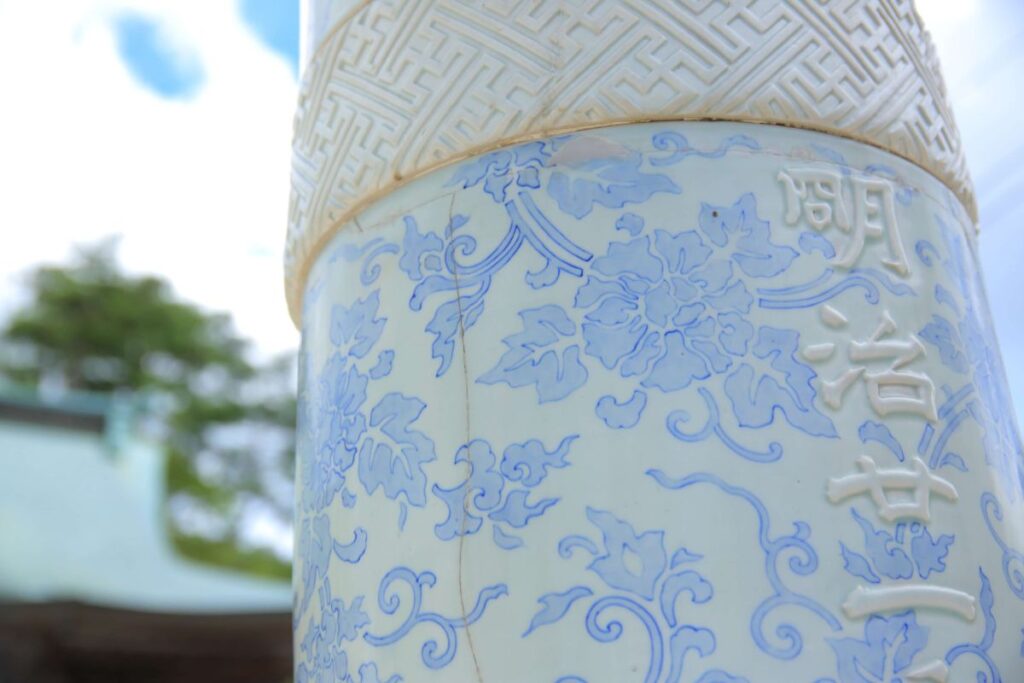
If you look closely, you can see that a lot of porcelain is combined into a single torii. It is just overwhelmed by the height of the technology of Aritayaki.
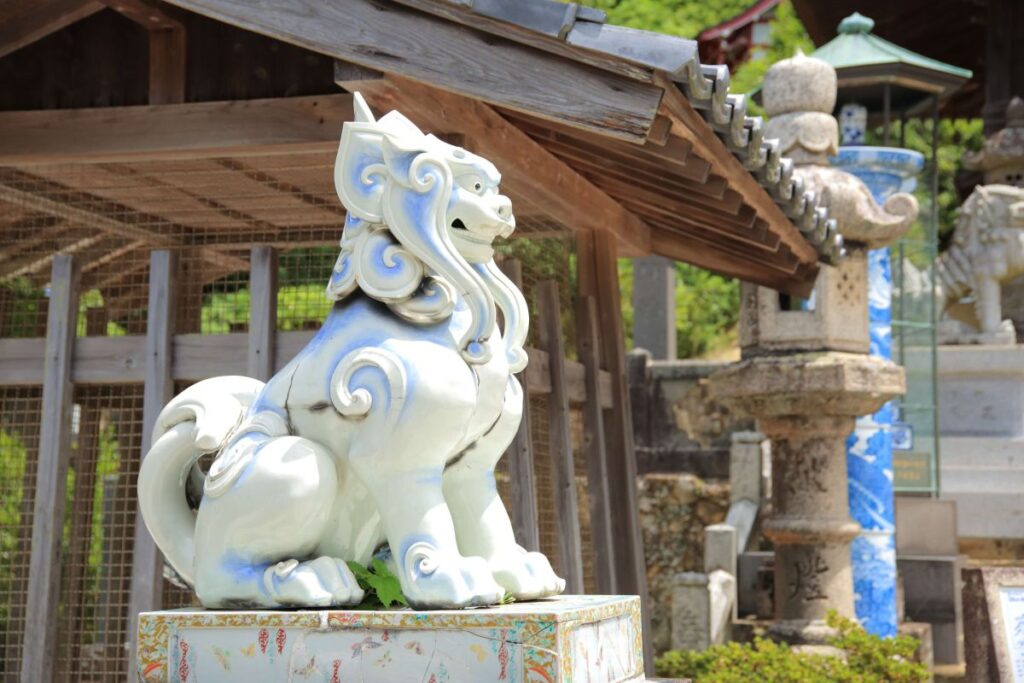
Near the Torii, a pair of Komainu line up on good terms. An adorable Komainu with a slightly unique face. It was dedicated in 1887, a year earlier than Torii, and this is also Aritayaki. In contrast to the simple figure of a Komainu with blue dyeing on white porcelain, the pedestal features butterfly and others in ornate Akae. The part that had been restored and damaged in the year of 2024 was reproduced by Mr. Imaemon Imaizumi as it was at the time, and you can compare it with the Akae part of the stand where the Komainu was riding, which was exposed to the rainy wind and became difficult to see.
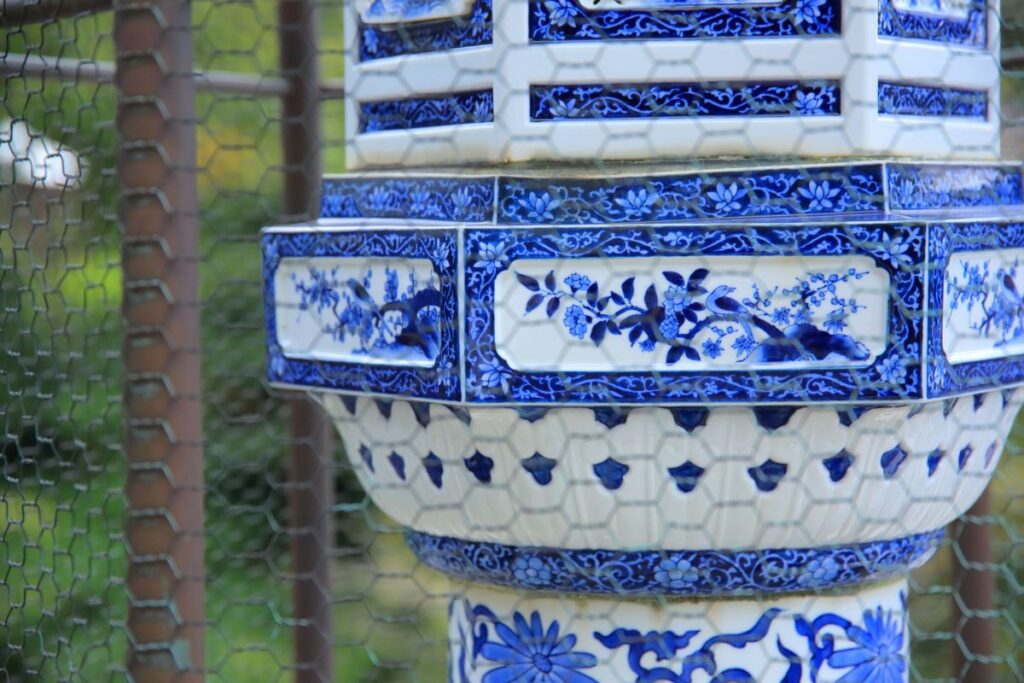
There are also large works such as porcelain lanterns, gate poles, and large water bottles with a diameter of 90 cm in diameter in the surrounding area where there is a hall of worship with white gravel. It was made from the Meiji era to the Showa era, and it is irresistible for pottery lovers.
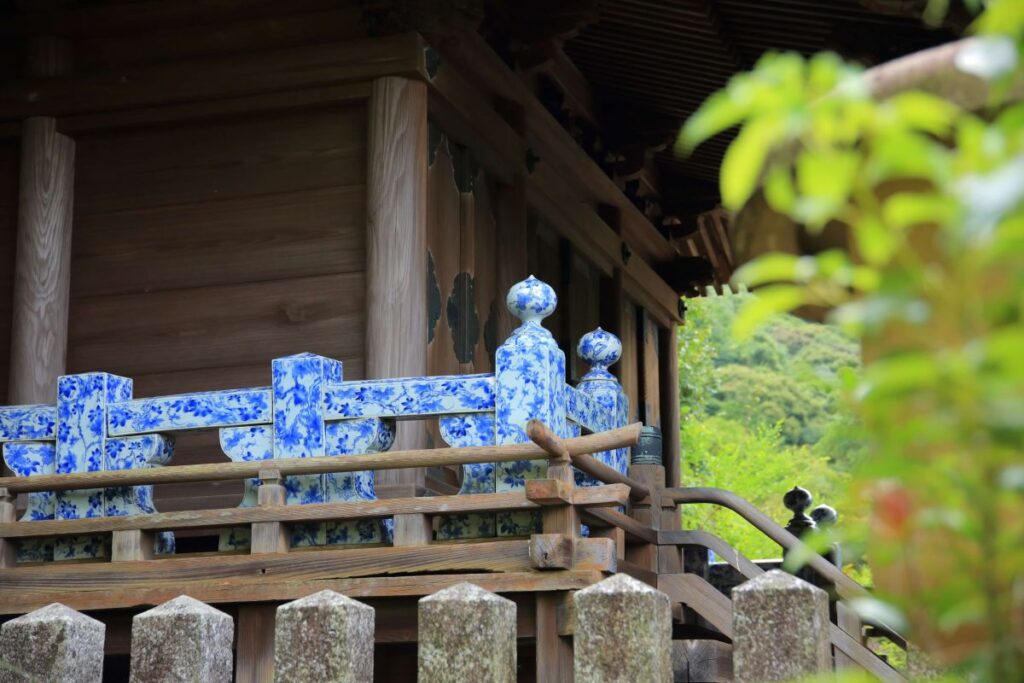
Also pay attention to the porcelain "Tamagaki" at the back of the worship hall! It is now arranged as a railing "koran" surrounding the main shrine, but it was originally dedicated in 1846 as a tamagaki surrounding the sanctuary of the shrine.
The total extension of the Tamagaki on the north and south sides is 6.2m. The surface is heavily painted with dense Tsurukusa patterns by Gosu. It is a rare, artful combination of porcelain members, and is also designated as an Important Cultural Property of the Town.
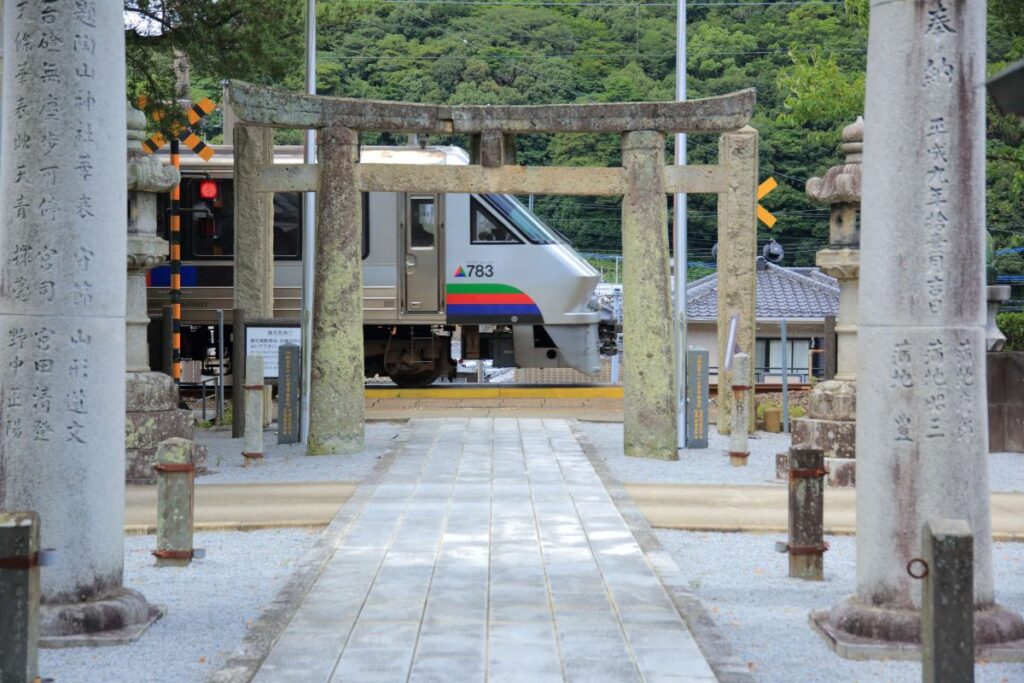
It is Sueyama Shrine, which has a lot to see, but encounters a more surprising sight. There is a track in front of the approach and there is a train through it! When the JR Sasebo Line was opened between Hakata and Sasebo, Arita had no place to be able to pass the track, and it was decided to pass the very end of the shrine.
There are about two to four trains per hour. It is unique to this shrine that you can meet a mysterious sight where express trains and regular trains run through. There is no blocking machine, so be careful when passing trains.
The amulet of Aritayaki burned in a kiln inside the shrine and the Ggoshuin book only in Japan
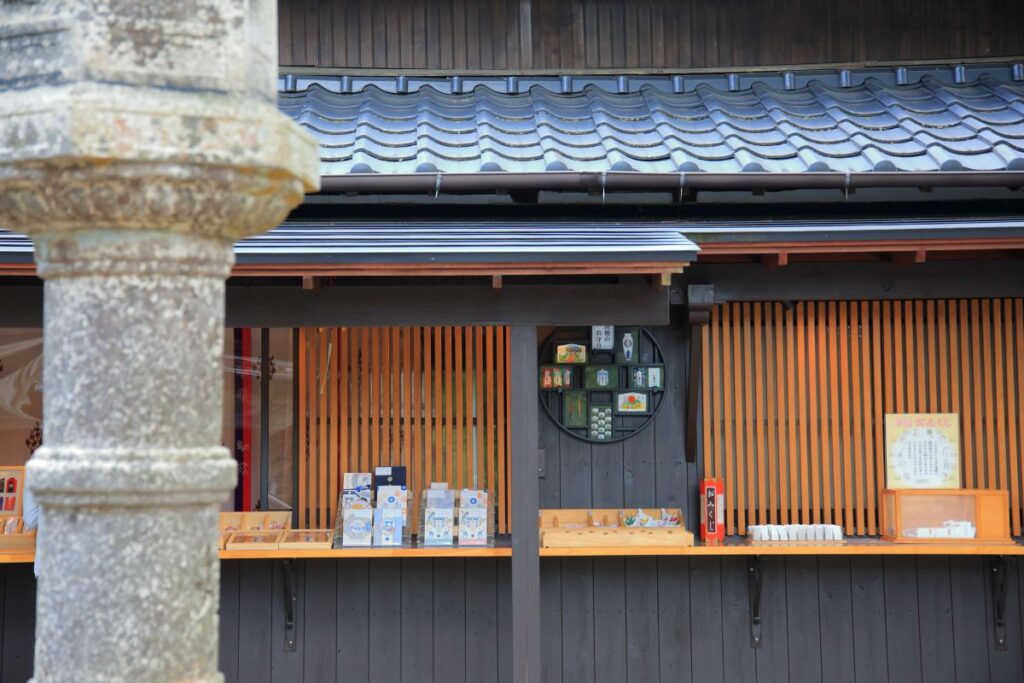
After the visit, go to the Shamusho. Of course, amulets and Ema are also made of pottery. And it is surprising that the amulets are burned in Klin inside of the shrine. I think that amulets by the priesthood themselves are very profitable.
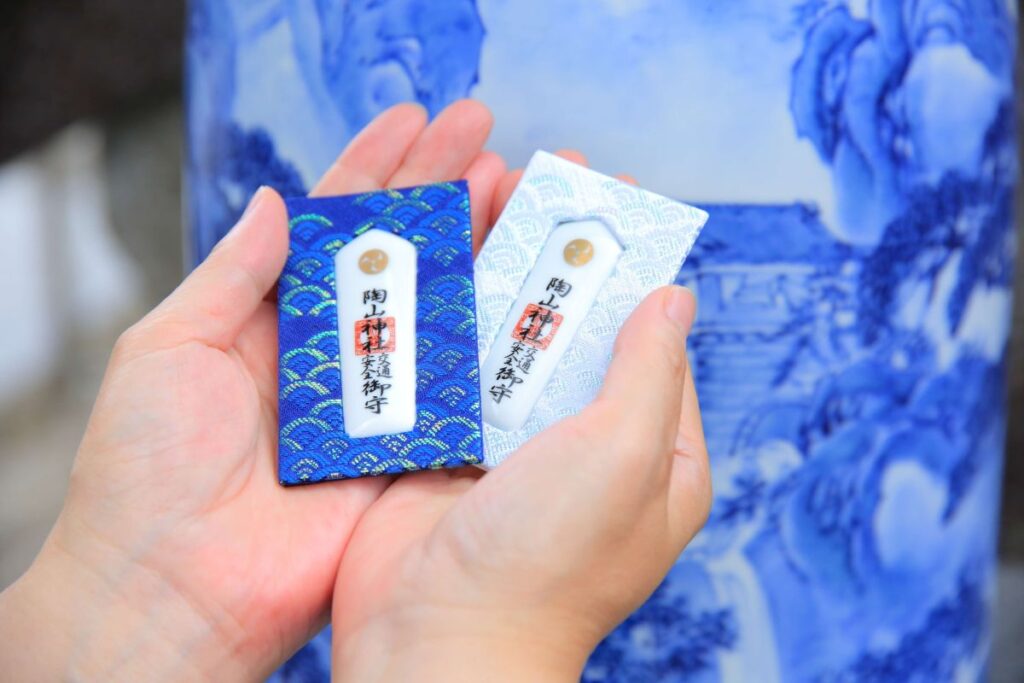
The picture is a sword-tip-shaped potter amulet, with a porcelain Komainu designed in the back, and a variety of traffic safety amulets, such as a slender type and a teacup-shaped with a lid (1000 yen each).
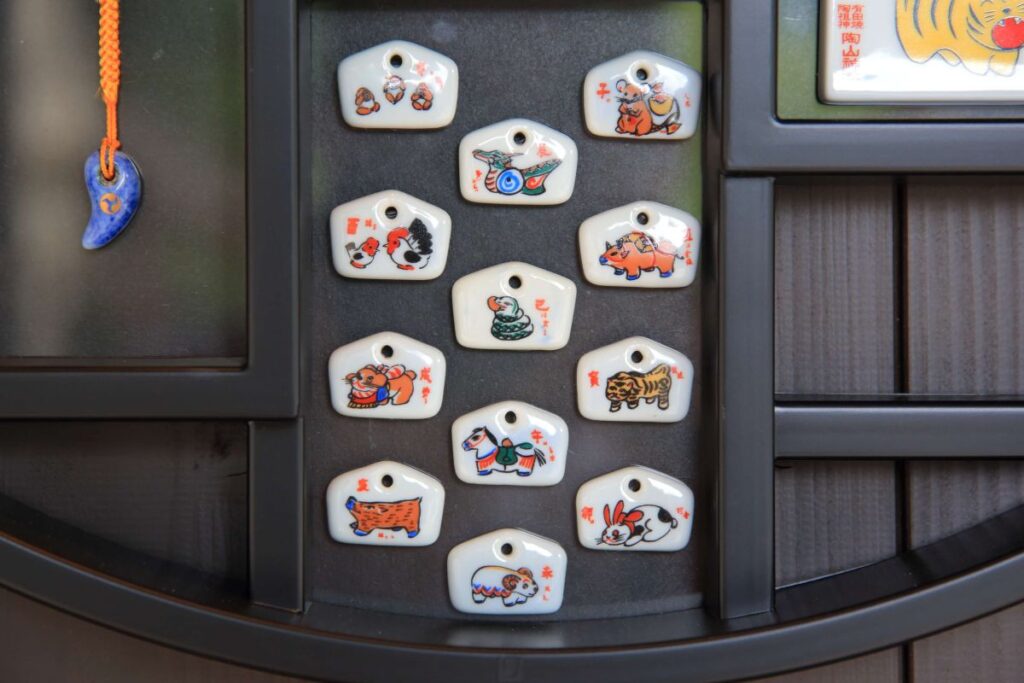
This is a root-type Aritayaki Ema with an adorable zodiac sign. It is the size of a small ride on the palm of the hand, and the Torii, the symbol of the shrine, is depicted on the back.
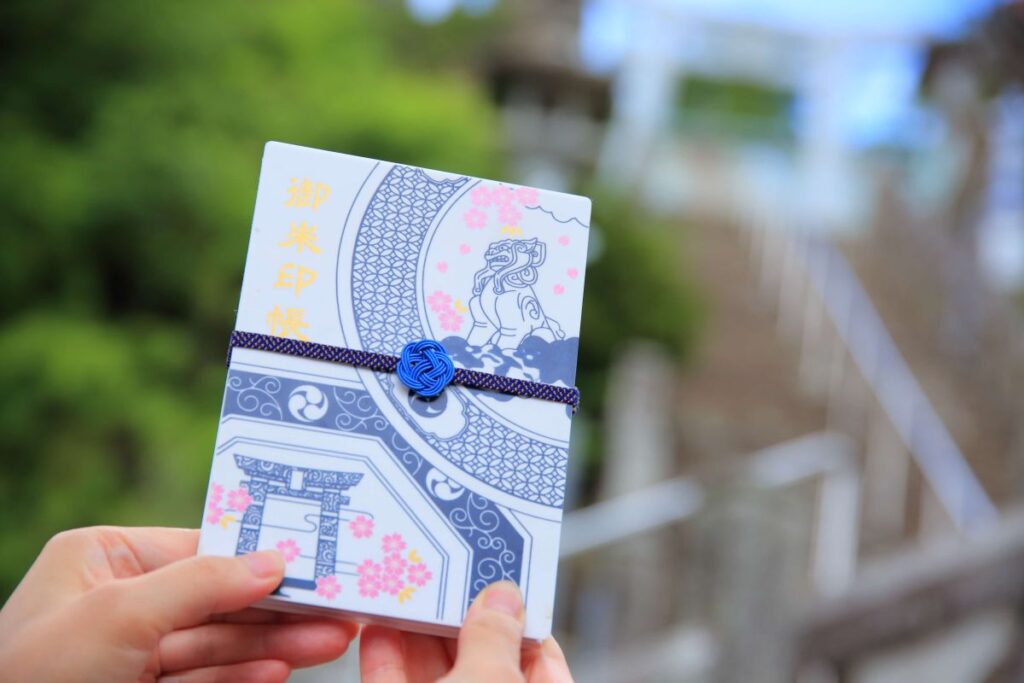
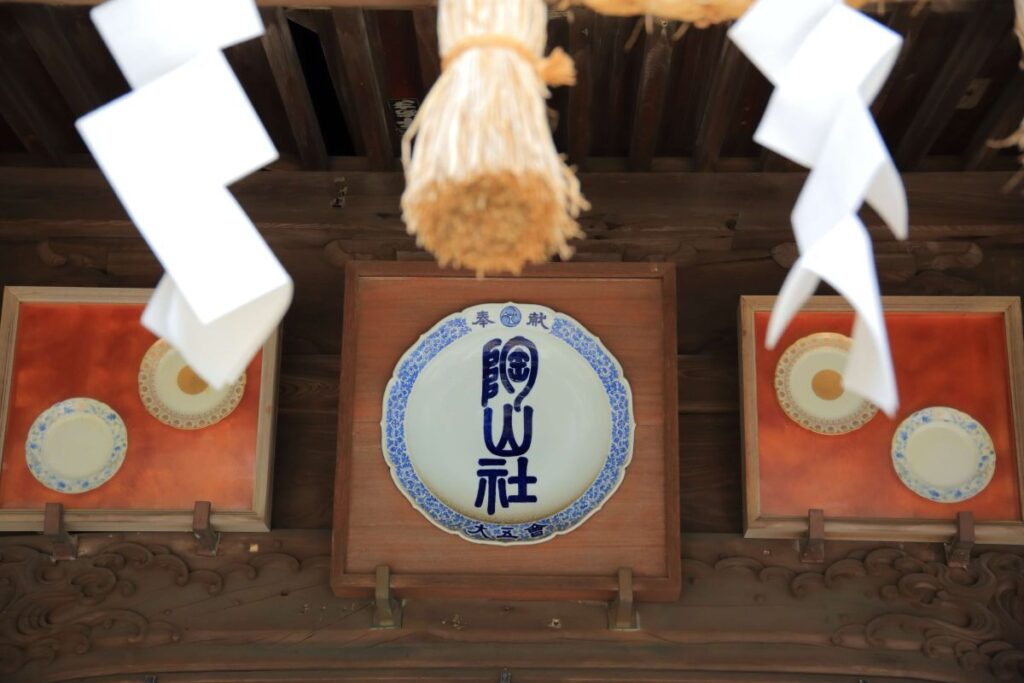
Goshuin book is also Aritayaki. The front cover and back cover are made of thin white porcelain, only 0.6mm thick, and the overall thickness is almost the same as that of an ordinary red seal book, and the weight is also 250g. The cover is an original design featuring the shrine's highlights Otoiri and Komainu on two plates, and the traditional pattern of Aritayaki is interspersed on the edge of the plate. According to the shrine, there is only one Goshuin book made of pottery in Japan.
Sueyama Shrine, which is also famous for cherry blossoms in spring, and a fall leaf spot of maples and ginkgo biloba in autumn. Cherry blossoms are good from late March to early April, and autumn leaves are from mid-November to early December. Why don't you enjoy it with the art of pottery that you can't meet at other shrines?
◾️ Sueyama Jinja
Address: 2-5-1 Otaru, Arita-cho, Nishimatsuura-gun, Saga
TEL:0955-42-3310
Opening hours: Free to worship (office from 9 to 17 o'clock)
Closed: No Closed
Fee: None
- This article is created based on the contents of "Rurubu Information Edition" or "Rurubu & more." "Rurubu +".
- The data listed are as of March 2025. Prices, business hours, regular holidays, menus, etc. may change or may not be available due to temporary holidays. Please check in advance when using it, as the content may change.
- The holiday of stores and facilities omits the year-end holiday, Obon holiday, Golden Week, and temporary holidays in principle.
- The published fees are in principle the fee including consumption tax that we have confirmed at the time of the interview, and the entrance fee is the adult fee if there is no special mention.
- In principle, the published times are open (hall) to closed (hall). Please note that the last order or entrance (hall) time is 30 minutes to 1 hour before the normal closing (hall) time. The last order is denoted LO.
- For the spring quality and efficacy of the hot springs listed, manuscripts are prepared based on answers from each facility.