 English
  Japanese
  Chinese (China)
  Chinese (Taiwan)
  Korean
 Tosa Fish Market

You can eat 5 kinds of nigiri-ten (from 125 yen each), including garlic and Edada beans, which are freshly fried. You can also visit the factory for free.

You can eat 5 kinds of nigiri-ten (from 125 yen each), including garlic and Edada beans, which are freshly fried. You can also visit the factory for free.

Forty-odd years in business. They are made from nita rice balls and traditional dashi-maki eggs from 4 in the early morning. More than 3000 eggs, which are used in one day when there are many, are combined with the trade secret dashi and seasoning, and are carefully baked by expert artisans. A set of about 10 kinds of rice balls (2 pieces) and a proud egg-yaki 350 yen ~. Handmade sandwiches and oden on sale all year are also popular.

Traditional bamboo work has been passed on in the city of Suzaki. Popular products in recent years have been slippers with excellent touch woven with bamboo skin. Rare products made of tiger spot bamboo [Torafu only], which grows only in the city of Anwa, in the city of Suzaki, can not be overlooked.
On two rocks, he prayed for maritime safety and built a Daishido, so he was called "two-stone Oshi-san".
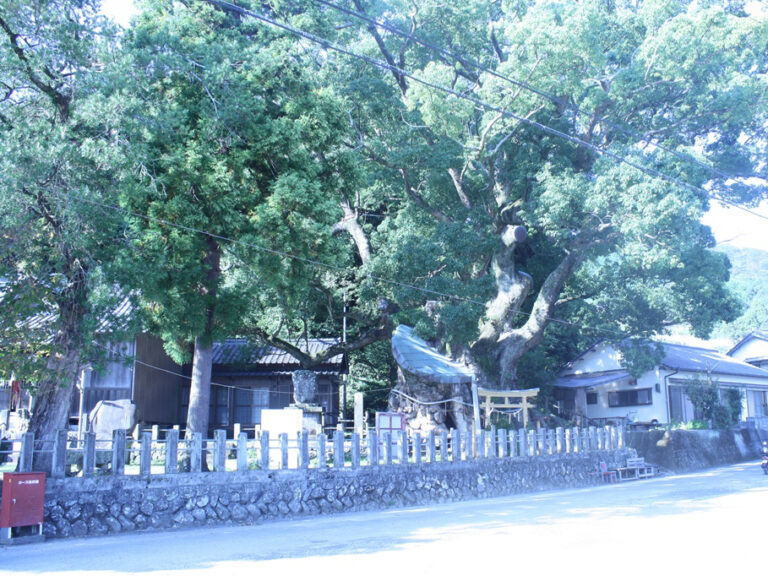
It was designated as a national natural monument in the year of Taisho 13 (1924) for its giant camphor tree, with a height of 25m and a base circumference of both, with an estimated age of 1300 years.

The rare cherry blossoms that bloom from February to around mid-March when there is still a flicker of snow. Nearly 1000 trees are planted on the slopes of a quiet mountain village, and the flowers of dark pink flowers bloom all at once are stunning. You can check the flowering situation on the official website of the Gōkyō-kōminkan, "Aso-mura-dakai".

A beautiful waterfall on the Shinshō River tributary. It is 37m high and 6m wide, and flows down a vertical cliff. Behind the bottom is somewhat depressed, and it is famous as a back-view waterfall that can be seen around the back of the waterfall. The area is designated as a prefectural nature park, and the broad-leaved fresh green and autumn leaves are stunning.
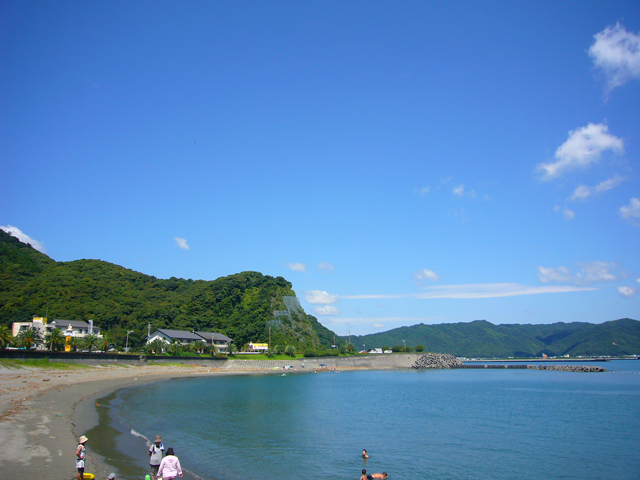
Blessed with gentle waves, you can enjoy a variety of marine leisure.
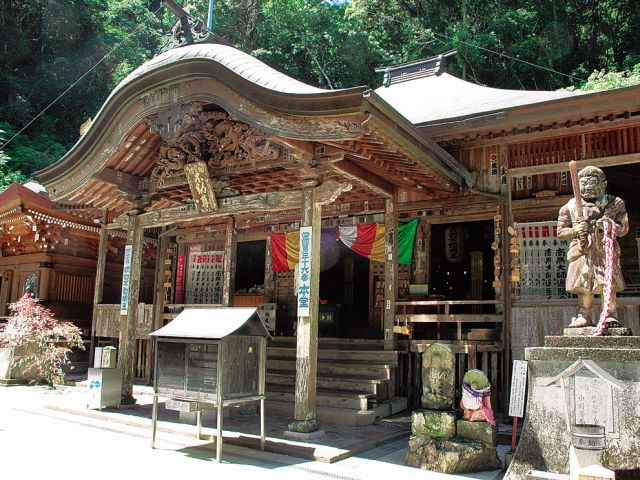
Shikoku Reiba No. 36 it is reported that the temple was opened by the discovery of the dokonoki, which was thrown by the Hiroho Daishi from the tang where he was trained. The statue of the main priest, Nami Kiri Fudomyo, has a strong faith in the fishing people, and many painting horses depicting ships are displayed in the main hall. It is said to be a Kamakura period work, and the wooden statue of Aizenmyo Oozazou is an important cultural property.
Uranouchi Bay on the northern side of the peninsula, embraced by the Yokonami Peninsula, is a scenic coast with deep inlets extending over about 12 kilometers (3 ri). It is also called Yokonami Sanri because the waves are gentle and it draws ripples in the horizontal direction, and the driveway Yokonami Kuroshio Line runs through the peninsula. The area is dotted with sightseeing spots such as the Kuroshio Observation Park and Goshiki-no-Hama.