 English
  Japanese
  Chinese (China)
  Chinese (Taiwan)
  Korean
 Customer Shrine
社殿入口から廻廊を進み、最初に参拝できる神社。平清盛の造営時の面影を残している。嚴島神社におけるほとんどの祭典はここから始まる。本社同様、国宝に指定されている。

社殿入口から廻廊を進み、最初に参拝できる神社。平清盛の造営時の面影を残している。嚴島神社におけるほとんどの祭典はここから始まる。本社同様、国宝に指定されている。
豊臣秀吉が建立した入母屋造の大経堂。工事の途中で秀吉が死去したため、天井の板張り、正面入口などが未完成のまま現在に至っている。畳を敷けば、857畳あるといわれるそのスケールの大きさから、通称千畳閣とよばれている。
嚴島神社の西側の丘に大永3年(1523)に建立された国の重要文化財。純和様を基調としながら、天竺様や禅宗様を取り入れた建築様式は周辺の景観とも融合し、深い朱の美しさを一層強めている。
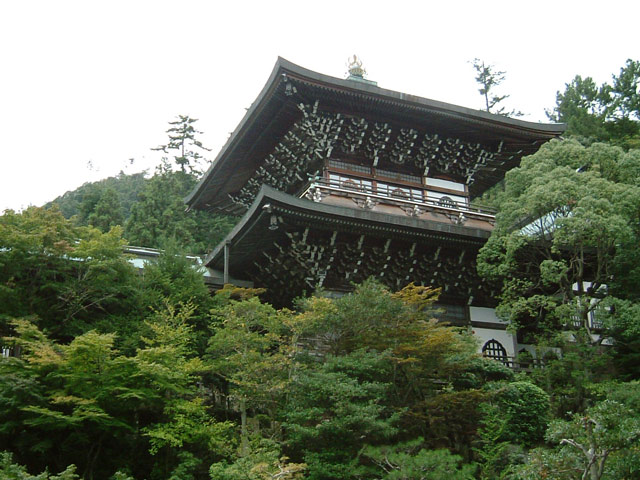
霊峰・弥山には、弘法大師の足跡を残す遺跡が各所にある。大聖院はそれらを統括する真言宗御室派の大本山であり、宮島で最古の歴史を持つ寺院である。本堂には、豊臣秀吉が朝鮮出兵の折、海上安全を祈願した波切不動明王が、観音堂には十一面観音菩薩が祀られている。
島民が宮島を今日の隆盛に導いた平清盛の遺徳をたたえ、霊を慰めるために昭和29年(1954)に創建した神社。西松原と呼ばれる砂州にあり、朱塗りの鳥居と小さな社がある。
An ingenious composition that makes the sea look into the grounds, and a magnificent old company that boasts the architectural beauty of Heian. It is reported to be the founding of the year of the throne of Suiko Emperor (593), and the third year of Nin'an (1168) Taira Kiyomori built a shrine building that incorporated the current style of Neden-no-tōzō. Focusing on the head office, the flat stage [Hira-butai] (national treasure) that protrudes into the sea, the high stage [Takabuta] (national treasure), the Noh stage [Nobuta] (important cultural property), the customer [Mauro] shrine (national treasure), more than 20 buildings, such as it is connected by a corridor of Zhu Ying, which extends a total length of about 270m.
One of the three views of Japan, along with Matsushima in Mutsu and Tenbashi in Tango. It is an island in the northwestern part of Hiroshima Bay with a circumference of about 30km, with Mishan [Misen] at an altitude of 535m, the highest peak. It has been called the "Island of the Gods" since ancient times, and the island itself has been a subject of faith. At present, the entire island is a country-designated special historic site and special famous city. The island is filled with attractions such as the island island island shrine, as well as the five-storied pagoda and the Sentatami-kaku, the Daishōin, the Hokuraya Park, and the Miyajima Aquarium. Strolling around the Omotesando shopping street and Machiya street is also fun. The island shrine, where the Ootorii and the shrine appear to have floated over the water during the high tide, was listed as a World Cultural Heritage Site due to its eccentricity and graceful architectural beauty, harmony with the natural beauty of the Miyama primitive forest behind it.
The mountain, which has been called the "Island of the Gods" since ancient times, is the highest peak of Miyajima, where the island shrine is located. In the first year of Datong (806), since the rebirth of Kobo Daishi, it was revered as a sacred peak of the mountain faith, and now the Miyama Primitive Forest is listed as a World Heritage Site along with the Ishima Shrine. The mood of walking through the primordial forest and looking for a large panorama from the summit is exceptional, as the words of Hirofumi Ito, "Do not climb Mount and discuss Miyajima." at an altitude of 535m, the summit is reached by connecting two ropeways, and a 30-minute walk from the terminus station through the main hall of Miyama and the Reido of Miyama. You can see the Seto Inland Sea from the summit observation deck. With shoes that are easy to walk because there are many stone steps and up and down.
The coast on the way to the road from the Omotesando shopping street in Miyajima to the island shrine. A large torii of granite stands, and the stone lanterns (stone lanterns) line up with the zurali. A large torii can be seen immediately in front of you, and it is also known by one of the eight views of Itsukushima, "Mikasahama-no-Hamahosetsu". It is the best spot to see the lit-up great bird, and the beauty of the evening view is exceptional.
It is a quaint spot lined with lit stone lanterns, with a full view of the island shrine, the Ootorii and the Mikasahama on the opposite bank.