Archives: Travel Post

Futarayama Shrine Copper Torii

The Torii, which is located next to the Futarayama Shrine Rōmon and is the entrance to the east side; the present one is the one that was rebuilt in Kansei 11 (1799); the lotus is carved at the foot, reminiscent of the Buddhist style.

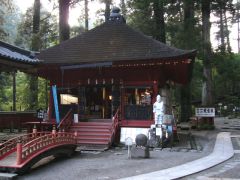
Futarayama Shrine Great Hall

A Hōgakuzukuri building that enshrines the great power priest [Ookuninushi Mikoto] in the shrine of Futarayama Shrine (paid). He is identified with Daikokuten and is familiar as the god of invitation. Inside, there is a statue of a great power, a great power of sunlight, and a treasure sword. On the second Saturday of every month (except June and December), there is a big day's fair, and on the first Saturday and Sunday of June, the Daikoku Festival is held.

Nikkō Tōshō-gū (Nikkō Tōshō-gū)

The building, which is decorated with a multi-chromatic sculpture, is visible on the left side of the Tōshōmiya precinct, just after passing through the Ninotorii. It is characterized by a double roof called the double-layered treasure-shaped structure, and the lower and upper layers are filled with plenty of kazi metal fittings up to the back of the soffit, and are sculpted in a polar chromatic color. Inside, there was an octagonal rotary reprint called the Wurzo, which contained 1456 copies of the Tenkai version, 6323 volumes. On its front is a wooden statue of a Chinese parent and child who invented the hozo. It is also called "laughing hall" because the children in the statue are laughing.

Nikko Tōshō-gū Yōmingun (Nikko Tōshō-gū Higuramun)

The highlight of the tour of the Tosho Palace, the Yangmingmon, is 11.1m high, 7m in front, and 4.4m on all sides, with sculptures of early Edo decorative techniques. The two-tiered tower gate, which is decorated with a polar chromatic color, has a variant name of Higurashi (Higurashi-mon) because it is impossible to see it even if you watch it all day. It is also called a twelve-legged gate because it is supported by twelve cylinders. It is said that the common people were not allowed to pass through this gate until the Meiji Restoration, and the samurai deposited their swords, and even the envoys changed their costumes.

Nikko Tosho-gong Honji-dou Onyorong

Honji-dō [honjido] (important cultural property), which stands in the precincts of the Tōshō-gū, and which delights the Prince of Ieyasu's guardian principal, Yakushi Nyorai. The dragon depicted on the ceiling of its chancel is the famous Naryong. Just under the dragon's head, when he hits the clap tree, the "kururururu" and reverberant sound reverberant sounds, a mechanism that makes it sound like a dragon's sound.

Nikko Tōshō-gū Honji-do (Nikko Tōshō-gū Yakushido)

It is the largest building of the Tosho Palace and is also known as Yakushido. It was built at the time of the Great Reproduction of Kanei, and is a brilliant structure with a single-layer Irimaki building, a height of 15m, a front of 20.8m, a side of 13m and a total lacquered color. At that time, Tokugawa Ieyasu was said to have been considered to be the incarnation of Yakushi Nyorai, and inside it is enshrined the main Buddha of the Tōtsuteru, Yakushi Nyorai. Also famous is the eirong painted on the ceiling. The Honji-do was burned down in 1961, and the current building was rebuilt in 1963-43.

Nikko Tōshō-gū East Corridor Sentinel Cat

A famous sculpture of a cat, located in the toad crotch of the East Corridor [Higashi-Kairokugurimon] (national treasure), in the East Corridor, precinct. It is also said to be a master craftsman, Jingoro left. Of the many sculptures of Tosho Palace, this cat is the only one whose author can be found. The back of the sculpture is designed with a pattern in which two sparrows fly and play together, and it is said to be a symbol of the world of Taiping in a pair with a sleeping cat.

Nikkō Tōshō Palace, Hundred Hundred of Dragons

The painting of 100 dragons, which are crowded on the ceiling of the shrine (national treasure), in the Tōshō-gū-gū, was painted by Kanō Tōyu (Kanō-Tantyu) and his side. The design of all the dragons one by one is drawn differently. The dragon, by the way, is also the zodiac of the 3rd Shōgunya.

Nikko Tosho Palace, Ishinomiya, Main Hall

The Gondingzo building that serves as the center of the Dongsheng Palace surrounded by the Tang Gate and the Tung Feng. On the ceiling of the hall of worship is raised the forehead of Hyakutan Hundred Species Dragon [Hyakutama Hyakushu no Ryu], and on the parapet is the forehead of a Tosa-school picture artist, the thirty-six kasen of Tosa Mitsuki [Tosamitsu] brush. The line of worship and the main shrine is connected by the stone line, and the general worship is up to the stone line in front of the main shrine.

Nikko Tosho-miya Nino Torii

A 6m high, bronze-built Torii, located in the Tōshō-gū precinct, between Mishōsha and Keizo. It was erected by Iemitsu during the Great Rebuilding of Kanei. The lower part of the Torii is carved with Lotus, which is often found in the Buddhist style, and it seems to be Nikko, the land of the shrine and Buddha. In addition, the precincts that can be seen from this area are beautiful and evenly arranged in front of the Yangming Gate, creating a wonderful landscape.

Contact Us: Business & Personal Inquiries

By proceeding, you agree to our Terms of Use And confirm you have read our Privacy Policy .

Notes

· We are available for inquiries 24 hours a day. Responses will be provided between 9:00 and 18:00 (including weekends, public holidays, and year-end/New Year holidays).
· Depending on the nature of your inquiry, it may take some time for us to respond.

RURUBU & ALL WAY JAPAN
Privacy Overview

This website uses cookies so that we can provide you with the best user experience possible. Cookie information is stored in your browser and performs functions such as recognising you when you return to our website and helping our team to understand which sections of the website you find most interesting and useful.